
Reviewed within 24 hours
ISO 9001 Certified Clinic
It’s one of the most common conditions in medicine, and one of the least talked about. Here’s what that silence costs you, how to manage hemorrhoids at home the right way, and the point where home care stops being enough.

If you’ve been sitting a little differently, skipping the gym, or rehearsing how to explain to a doctor what’s wrong without dying of embarrassment — you are nowhere near alone, and there is nothing unusual about you. Learning how to manage hemorrhoids at home is the first step most people take, often quietly and alone, long before they consider talking to anyone about it.
Hemorrhoids affect an estimated one in twenty adults at any given time, and by some estimates, around half of all adults will deal with them by age 50. That makes them about as common as the common cold. And yet, unlike a cold, most people don’t mention them to anyone — not their partner, not their closest friend, sometimes not even their doctor until the discomfort becomes impossible to ignore.
That silence is understandable. It’s a part of the body we’re taught not to talk about, tied to a function we’re taught to be private about. But the embarrassment does something quietly costly: it keeps people managing pain alone, guessing at home remedies, and delaying care long past the point where a five-minute conversation would have helped.
This isn’t about pushing you toward treatment you don’t need. Plenty of hemorrhoid flare-ups genuinely do resolve with home care. This is about helping you tell the difference — between “this will pass” and “this is the thing making my life smaller than it needs to be.”
Hemorrhoids rarely stay contained to the bathroom. For a lot of people, they reshape the whole day in small, cumulative ways:
Sitting. Long meetings, commutes, flights, and desk work all become something to plan around — the aisle seat, the extra cushion, the standing desk you suddenly need.
Exercise. Cycling, running, and weightlifting can all aggravate symptoms, so it’s common to quietly stop rather than explain why.
Sleep. Discomfort that’s easy to ignore during a distracted day can be the thing keeping you awake at night.
Intimacy. Pain, self-consciousness, or fear of a flare-up can make people withdraw from their partner without explaining why.
Diet and travel. Constant low-level anxiety about what you eat, when you’ll have access to a bathroom, or whether today is a “bad day.”
None of this shows up on a symptom checklist, but it’s often the real reason people finally seek treatment — not the physical symptom itself, but how much smaller their life has gotten around it.
The embarrassment isn’t irrational. It’s just costing you more than the conversation would.
For mild to moderate hemorrhoids, home remedies for piles genuinely work for a lot of people, especially early on — the goal is to reduce straining and swelling while your body does the rest.
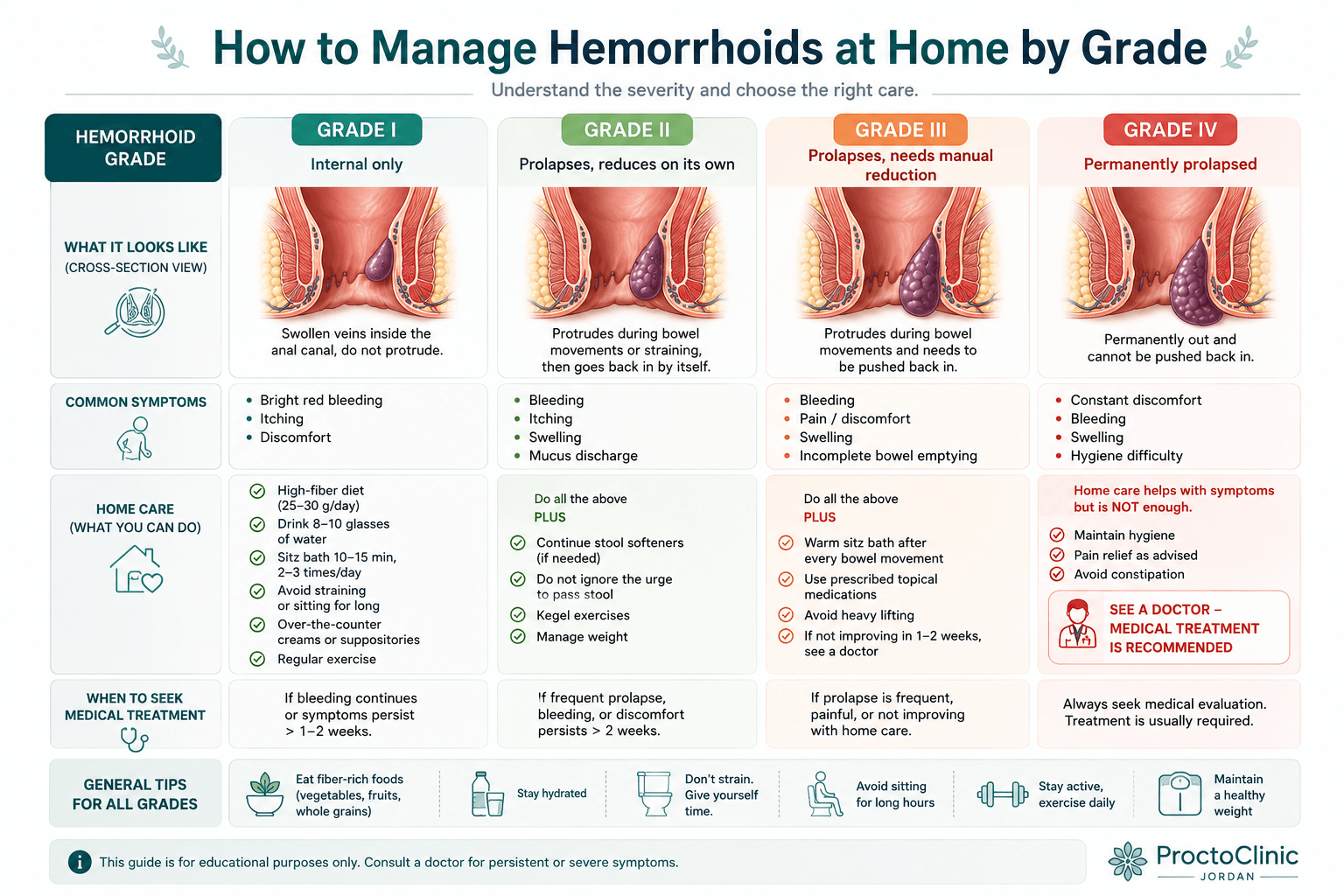
Done consistently, this combination resolves a genuine flare-up for a lot of people within one to two weeks. If you’re doing all of this and not seeing any improvement in that window, that’s useful information — not a sign you’re doing something wrong, but a sign it’s worth having someone actually look.
There’s no clear timeline, because it depends on what you’re dealing with, but here’s a reasonable way to think about it:
Grade I–II
Mild — usually fine to manage at home firstInternal hemorrhoids that don’t protrude, or protrude but return on their own. Two weeks of consistent home care is a reasonable trial before checking in with a doctor.
Grade III
Moderate — worth getting evaluated, not urgentProtrudes and needs to be pushed back in manually. Home care can still help day-to-day, but this is a good time to get a professional opinion rather than keep managing alone indefinitely.
Grade IV
Advanced — schedule a consult, don’t wait it outPermanently protruding and can’t be pushed back in. Home care won’t resolve this on its own, and waiting typically means living with worsening symptoms rather than any risk of the problem quietly fixing itself.
Outside of grading, a simpler personal rule works too: if symptoms are mild and improving with home care, it’s reasonable to keep managing them for a couple of weeks. If they’re not improving, getting worse, or coming back every few weeks, that’s the signal to stop waiting — not because something catastrophic is imminent, but because there’s no upside to living with it longer than you have to.
A few symptoms are worth acting on right away rather than waiting out the usual two-week trial:
Most people don’t need surgery. The majority of cases resolve with lifestyle changes, or with quick in-office procedures like rubber band ligation that take minutes and require no real downtime. Surgery is typically reserved for a smaller group:
If you’re at this point, it’s worth knowing that modern options like laser hemorrhoidectomy involve far less downtime than the “traditional surgery” most people picture — usually one to two weeks of recovery rather than a longer hospital-style ordeal, and it’s often done as a same-day outpatient procedure.
Every proctologist has this conversation multiple times a day. Nothing about your symptoms will surprise or embarrass the person examining you — this is the entire focus of their work, not an unusual case they’ll remember. The hardest part is almost always making the appointment, not the appointment itself.
Mild symptoms are usually fine to manage at home for one to two weeks with fiber, hydration, sitz baths, and OTC relief. If that’s working, keep going. If it isn’t — or if you’re dealing with heavy bleeding, a prolapse that won’t go back in, or sudden severe pain — that’s your signal to get seen, not to try harder at managing it alone. And if it’s the embarrassment holding you back more than the symptoms themselves, that’s worth naming to yourself honestly, because it’s the one factor that costs you time without actually protecting you from anything.
Curious what treatment actually costs?
See our full breakdown by procedure type, including in-office options that cost less than you’d expect.
Explore more guides on conditions we treat and options for patients in the US:
Common Questions
The most effective way to manage hemorrhoids at home is to increase fiber intake, drink more water, take warm sitz baths a few times a day, and use an over-the-counter cream or witch hazel wipes for short-term relief. Avoiding straining and prolonged sitting also helps significantly.
For mild to moderate cases, consistent home care typically shows improvement within one to two weeks. If you’re not seeing any change in that window, it’s a reasonable point to check in with a doctor rather than continue indefinitely.
Mild, Grade I–II hemorrhoids often do resolve on their own or with home care alone. More advanced hemorrhoids (Grade III–IV) usually don’t resolve without medical treatment, since the underlying tissue changes don’t reverse on their own.
See a doctor if home care isn’t improving symptoms after two weeks, if a hemorrhoid stays prolapsed and won’t go back in, if there’s heavy or ongoing bleeding, or if you experience sudden severe pain with a hard lump, which can indicate a thrombosed hemorrhoid.
A brief cold compress followed by a warm sitz bath tends to offer the fastest relief for acute discomfort, alongside an over-the-counter numbing cream. This addresses the swelling and pain in the moment, but consistent fiber and hydration are what actually resolve the underlying cause.
A short consult can tell you in minutes whether home care is enough, or whether it’s time for something more. No judgment, no lecture — just a straight answer.
ProctoClinic · New York, NY & Chicago, IL · This article is for general information and isn’t a substitute for medical advice.

Advanced Laser Proctology · Amman
A specialist laser proctology clinic in Amman, Jordan. Serving international patients from the U.S., Europe, and the Arab world with minimally invasive anorectal care and same-week scheduling.
ISO 9001 Certified Clinic
9,000+ procedures completed
Jordan Trained Doctors
Lady doctor available for female patients
© 2026 Proctoclinic Jordan. All rights reserved.