
Reviewed within 24 hours
ISO 9001 Certified Clinic


Quick Answer
Most patients in the United States wait 4 to 6 months to see a hemorrhoid specialist and receive surgical treatment — and in major cities like New York and Chicago, the wait can stretch even longer. A first gastroenterology or colorectal surgery appointment alone now takes an average of 40 days (AMN Healthcare, 2025), and surgical scheduling adds weeks or months on top of that. If your symptoms are severe, that wait is not just uncomfortable — it can allow the condition to worsen.
You searched for this because you already know something is wrong.
Maybe it’s been weeks of pain every time you sit down. Maybe you’ve noticed bleeding that won’t stop. Maybe you’ve tried creams, fiber supplements, and warm baths — and none of it is working anymore. And when you finally called a specialist’s office, you were told the first available appointment is in three months.
That response is more common than most people realize, and it is one of the most frustrating realities of getting colorectal care in the United States today.
This guide explains exactly what’s happening, what it means for your health, and — most importantly — what you can actually do about it.
40 days
avg wait for gastroenterologist (AMN 2025)
4–6 mo
total wait reported by patients before treatment
+19%
rise in specialist wait times since 2022
This is not a problem any individual clinic created. It’s a structural issue decades in the making. According to the 2025 AMN Healthcare Survey — covering 15 major US metro areas including New York and Chicago — the average wait for a new gastroenterology appointment is now 40 days, up 19% since 2022 and up 48% since 2004.
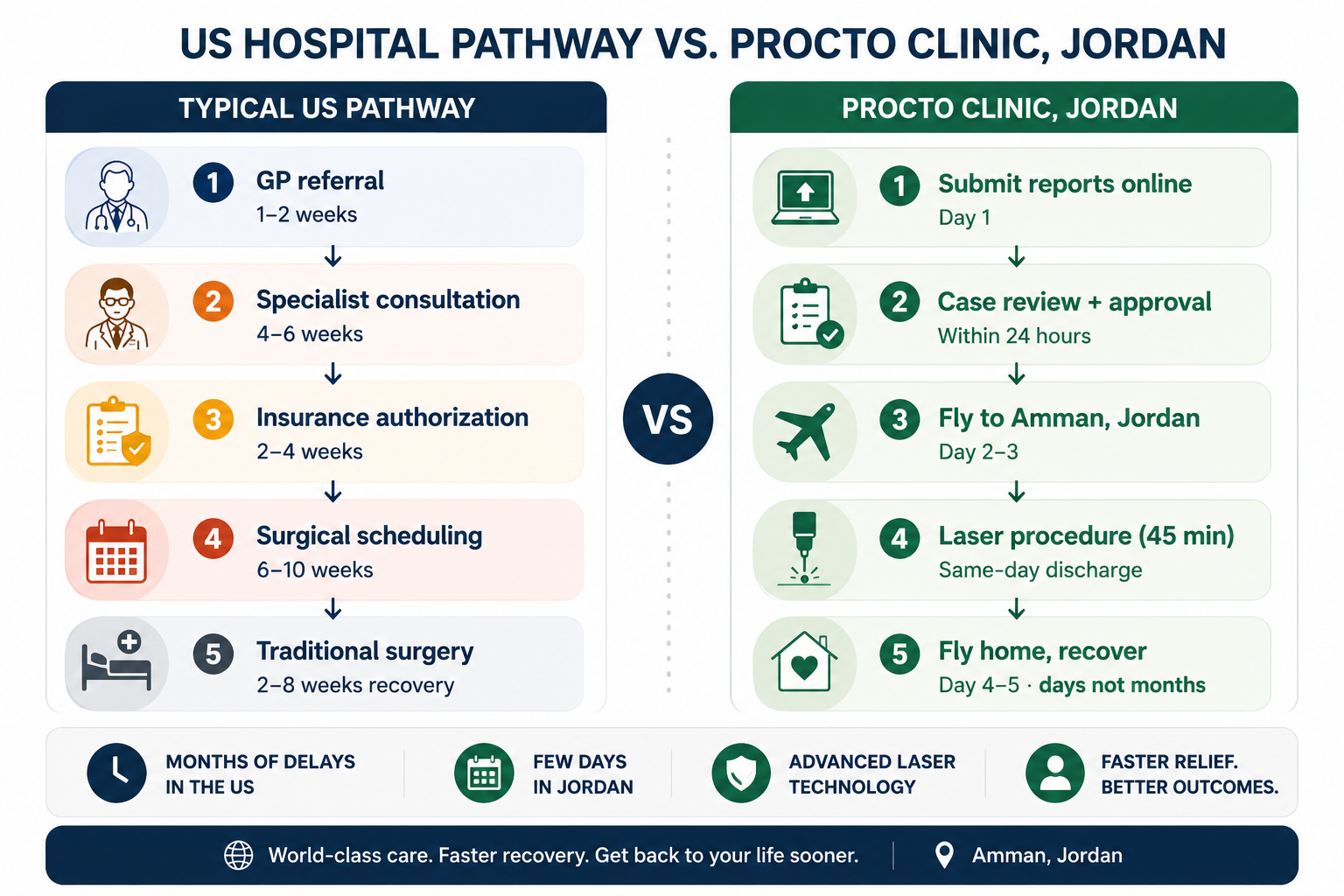
But that 40 days is just the consultation. If surgery is needed, you then enter a second queue for operating room availability. For non-urgent elective procedures — how most hemorrhoidectomies are classified — that adds another 6–10 weeks. Insurance pre-authorization sits in between, adding 2–4 more weeks.
A growing physician shortage. The AAMC projects a deficit of up to 86,000 doctors by 2036. Colorectal specialists are already hard to access.
Insurance authorization layers. Insurers often require documentation of failed conservative treatment before authorizing surgery — adding weeks.
Hospital consolidation. Operating room time is a shared, scarce resource allocated across many competing departments.
Embarrassment-driven delay. Many patients wait weeks before making a first call, entering the queue with a more advanced condition.
Hemorrhoids progress on a grade scale from 1 (mild internal swelling) to 4 (permanently prolapsed). The longer treatment is delayed, the higher the likelihood of progression. If conservative measures haven’t resolved your symptoms within 4–6 weeks, the underlying issue is unlikely to self-resolve.
Don’t wait — seek emergency care if you experience:
If you’re currently in the queue for a US specialist, the following genuinely help reduce symptoms and prevent progression.
Increase dietary fiber to 25–35g daily. Softens stool, reduces straining, directly reduces pressure on hemorrhoidal tissue. Psyllium husk (Metamucil) is effective and low-cost.
Hydrate aggressively — 8–10 glasses of water daily. Dehydration makes stool harder, which worsens straining.
Sitz baths twice daily. Warm (not hot) water for 15 minutes, especially after bowel movements. Reduces inflammation and provides relief.
Avoid prolonged sitting on the toilet. Sitting increases pressure on the anal area. Limit bathroom time and never bring your phone.
Use a donut cushion if needed. For patients with significant external hemorrhoid swelling, pressure-relieving cushions can make daily life more manageable.
Keep a symptom log. Document bleeding episodes and any changes. Useful for your specialist — and for submitting your case for an overseas review.
What to Avoid
Not all hemorrhoid situations can safely wait 4 to 6 months. There are specific symptoms that require urgent or emergency evaluation, regardless of the appointment queue:
Heavy or continuous rectal bleeding — not just a few drops, but blood filling the toilet bowl or soaking through clothing
Severe, sudden anal pain — especially if accompanied by a visible, hard, dark-colored lump, which may indicate a thrombosed external hemorrhoid
Prolapsed hemorrhoid that cannot be manually reduced — hemorrhoid tissue that protrudes and cannot be gently pushed back inside
Signs of infection — fever, chills, increasing swelling, or discharge in the anal area
If you experience any of the above, go to an emergency department or urgent care clinic that day. Do not wait for your scheduled appointment.
A growing number of patients — particularly those from Arabic-speaking communities in the US — are exploring laser hemorrhoid treatment abroad as a direct response to the wait time crisis.
At Procto Clinic in Amman, Jordan, the process works as follows:
Step 1
Submit your medical reports online.
You don’t need to travel to get a diagnosis. You share your existing reports, photos if applicable, and symptom history. Our specialist reviews your case within 24 hours.
Step 2
Receive a treatment plan and scheduling date.
If you are eligible for laser treatment, we provide a detailed plan and can schedule your procedure within days — not months.
Step 3
Travel to Jordan.
Queen Alia International Airport is a major hub with direct flights from New York (JFK) and connections from Chicago. The clinic is approximately 30 minutes from the airport.
Step 4
Procedure and recovery.
The laser hemorrhoid treatment takes 30 to 45 minutes and is performed under anesthesia. Most patients are discharged the same day. The majority of our international patients spend 3 days in Jordan total before traveling home comfortably.
Step 5
Follow-up remotely.
Post-procedure support and follow-up consultations are conducted via WhatsApp and video call.
Traditional hemorrhoidectomy (surgical removal) typically involves general anesthesia, a hospital stay, and a recovery period of 2 to 8 weeks before patients can return to full activity.
Laser hemorrhoid treatment — the method we specialize in at Procto Clinic — is minimally invasive. It uses concentrated laser energy to shrink hemorrhoidal tissue with precision, causing less damage to surrounding tissue, significantly less post-procedure pain, and a much faster return to normal life.
The procedure is performed by Dr. Aref Hammam, a proctology specialist with over 15 years of experience and more than 9,00 laser procedures completed. A female specialist, Dr. Maha Mohammadi, is available for patients who prefer a female doctor — a consideration that matters greatly to many of our Arabic-speaking patients.
The clinic operates under ISO 9001 certification, meaning our quality management systems meet internationally recognized standards for patient safety and care consistency.
Common concerns
We understand that considering treatment abroad raises real questions. Here are the ones we hear most often — answered directly.
Is it safe? Is the medical standard comparable to the US?
Procto Clinic is an ISO 9001 certified facility. Dr. Aref Hammam completed his training in the United States and has performed over 8,500 laser procedures. Laser proctology is a well-established technique used in leading medical centers across Europe, the US, and the Middle East. The laser systems we use are internationally approved medical devices.
Is the total trip actually cheaper than staying in the US?
In many cases, yes — particularly for patients without insurance or with high deductible plans. Traditional hemorrhoid surgery in the US can cost $10,000 to $20,000 or more when you factor in surgical fees, anesthesia, hospital charges, and follow-up care. Our transparent pricing covers the procedure itself, and the cost of flights and 3 nights in Amman is typically a fraction of the US surgical bill. We provide a full cost breakdown during your case review.
What if I have complications after I return home?
All our international patients are supported via WhatsApp and video consultation following their return. If a complication requires in-person evaluation in the US, we provide full documentation of the procedure performed to share with local physicians. In 15 years of practice, serious post-procedure complications requiring emergency intervention are extremely rare in our laser procedures.
I can’t just fly to Jordan — what about my family, my job?
Most patients spend only 3 days in Jordan. Many US patients combine the trip with a short visit to family in the Levant, making the travel less disruptive. The procedure itself is same-day; you are not admitted to a hospital. We have worked with patients who traveled alone, with a spouse, and with extended family. Our team communicates in both English and Arabic throughout the process.
Common Questions
Submit your reports for a free specialist review. We respond within 24 hours — in English and Arabic.
Advanced Laser Proctology · Amman
A specialist laser proctology clinic in Amman, Jordan. Serving international patients from the U.S., Europe, and the Arab world with minimally invasive anorectal care and same-week scheduling.
ISO 9001 Certified Clinic
9,000+ procedures completed
Jordan Trained Doctors
Lady doctor available for female patients
© 2026 Proctoclinic Jordan. All rights reserved.