
Reviewed within 24 hours
ISO 9001 Certified Clinic

Quick Answer
Laser surgery for hemorrhoids, fissures, fistulas, and pilonidal cysts offers significantly less pain, faster recovery (days vs. weeks), and fewer complications than traditional surgery — with near-identical long-term outcomes. The key difference: laser energy shrinks tissue without cutting or stitching, eliminating the bleeding and tissue damage that make traditional surgery harder to recover from. Modern 1470 nm diode lasers have a margin of error of just ~1 mm and virtually no burn risk.
In a recent televised interview, Dr. Aref Hammam — Consultant in General Surgery, Laparoscopic Surgery, and Laser Surgery at Procto Clinic Jordan — was asked to settle one of the most common patient questions: is laser surgery actually better, or is it expensive marketing? His answer, drawn from over 8,500 procedures, was direct.
Dr. Aref Hammam discusses laser vs. traditional surgery in a televised interview. Translated from Arabic — English subtitles available.
What can laser treat?
Dr. Aref uses the diode laser — the medically accepted type for proctological surgery — to treat four main anal conditions:
“Lasers outperform traditional surgery in aspects like pain and complications, which are significantly lower. While the overall long-term results might be comparable to traditional surgery, the recovery time is much faster.”
— Dr. Aref Hammam, televised interview (translated from Arabic)
Side-by-side comparison
Dr. Aref uses the diode laser — the medically accepted type for proctological surgery — to treat four main anal conditions:
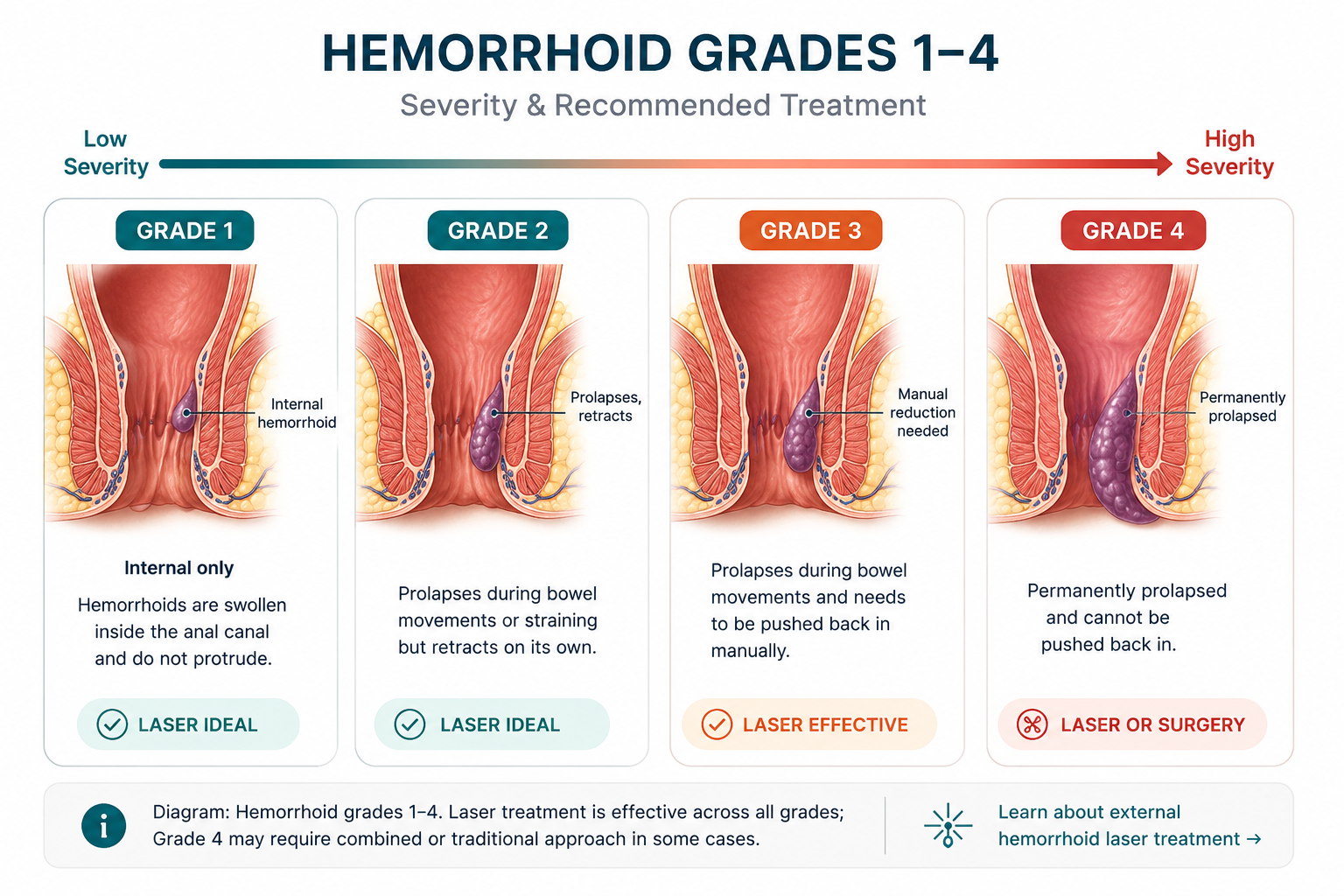
Understanding hemorrhoid severity
Hemorrhoids are classified in four grades. Laser treatment is effective across all grades, but the approach and energy delivered by the surgeon varies. Dr. Aref customises the laser dosage in Joules based on the specific grade.
The technology behind it
This was the sharpest question in the interview. Dr. Aref’s answer reveals why modern laser proctology is fundamentally different from what many patients imagine when they hear the word “laser.”
“Previously, devices used a wavelength of 980 nanometers, which distributed heat more randomly. Today’s modern devices use 1470 nanometers, which specifically targets red blood cells and is absorbed by blood — so it doesn’t damage surrounding tissue. The margin of error is nearly limited to just 1 millimeter.”
— Dr. Aref Hammam
~1 mm
margin of error with modern diode laser devices
1470 nm
wavelength targets only blood cells — spares healthy tissue
0 cuts
to sphincter muscle during laser fistula treatment
1 week
typical recovery vs. 4–6 weeks for traditional surgery
Dr. Aref also noted that a cooling fluid is injected during the procedure, creating a physical barrier between diseased and healthy tissue — a second protection layer against thermal spread. The risk of burns, he stated, is “almost non-existent” with properly trained surgeons using current equipment.
Safety & pre-op requirements
This is where Dr. Aref issued one of the most important warnings of the entire interview — directly addressing a dangerous trend in the region.
⚠️ Critical safety warning from Dr. Aref Hammam
“I have seen cases coming from neighboring countries where the procedure was done in a regular clinic, resulting in far more severe and dangerous complications — severe infections and bleeding. Instead of solving the problem, it worsened it. So, full precautions must be taken in an operating room, just like any traditional surgical operation.”
— Dr. Aref Hammam
Why laser isn’t yet universal
“Traditional surgery has been around for 80 or 90 years. Lasers have been used in this specific field for only about 20 years. The cost of the laser equipment and disposable fibers is much higher. And widespread medical expertise is still developing.”
— Dr. Aref Hammam
Dr. Aref drew a direct parallel to laparoscopic surgery: when it was first introduced for gallbladder removal and appendectomies, surgeons themselves were skeptical. Today, open surgery for those conditions is largely obsolete.
“The same thing is happening with lasers. In some neighboring countries, like the UAE, traditional surgery for these conditions is already a thing of the past. It is rare to hear of someone undergoing traditional surgery there — it has almost entirely shifted to lasers.”
— Dr. Aref Hammam
Explore more guides on conditions we treat and options for patients in the US:
Common Questions
Submit your reports for a free specialist review by Dr. Aref. We respond within 24 hours — in English and Arabic.
This article is based on a televised interview with Dr. Aref Hammam. Translated from Arabic. Published July 2026. For informational purposes only — not a substitute for medical advice. Consult your doctor before making treatment decisions.
Advanced Laser Proctology · Amman
A specialist laser proctology clinic in Amman, Jordan. Serving international patients from the U.S., Europe, and the Arab world with minimally invasive anorectal care and same-week scheduling.
ISO 9001 Certified Clinic
9,000+ procedures completed
Jordan Trained Doctors
Lady doctor available for female patients
© 2026 Proctoclinic Jordan. All rights reserved.