
Reviewed within 24 hours
ISO 9001 Certified Clinic


Most patients who reach me have already been living with hemorrhoids for months — sometimes years. They have tried every cream, every home remedy, every change in diet that a YouTube video or a family member suggested. By the time they sit in front of me, they are not asking whether laser treatment works. They are asking why nobody told them about it sooner.
After more than 15 years performing laser proctology and completing upward of 8,500 procedures, I want to give you a straight, experience-based answer to one of the most common questions I receive: Is laser hemorrhoid treatment actually better than traditional surgery — or is it just more expensive?
The honest answer is yes, it is clinically superior for the vast majority of patients. Not because laser is new or fashionable, but because of what it does not do to the body — and how quickly the body responds as a result. Here is what the evidence, and fifteen years of patient outcomes, actually shows.
Traditional hemorrhoidectomy — the surgical removal of hemorrhoidal tissue — has been the standard treatment for decades. It works. But the mechanism is blunt: the swollen tissue is physically cut away, the area is sutured closed, and the body then heals an open wound in one of the most sensitive and frequently used parts of the anatomy.
That healing process is what drives the experience most patients describe afterward: severe pain for the first week, significant discomfort for two to four weeks, and a recovery period of up to six weeks before returning to normal activity. Complications — including delayed wound healing, infection, and in some cases effects on sphincter control — are not rare. For patients managing diabetes, hypertension, or other chronic conditions, the surgical stress involved also carries additional medical consideration.
— Worth knowing
Traditional surgery remains a valid option in a small number of cases — particularly very advanced Grade 4 hemorrhoids with specific anatomical presentations. But in my clinical experience, it is rarely the only option, even for Grade 4. The question is whether the surgeon treating you has enough laser experience to offer it as an alternative rather than defaulting to what they know best.
Laser Hemorrhoidoplasty — LHP — does not cut or remove tissue. Instead, a fine laser fiber is introduced into the hemorrhoidal tissue, where controlled thermal energy causes the blood vessels feeding the hemorrhoid to close and the tissue itself to shrink. No wound is created. No sutures are placed. The surrounding tissue is left intact.
Because there is no open wound to heal, the recovery equation changes entirely. Most of my patients experience mild soreness after the procedure — manageable with the medications prescribed — and are walking normally within the first 24 hours. Patients who have traveled from the United States or the Gulf routinely return home within three days.
“I thought I’d need weeks to recover. I was back to walking around the hotel the same evening.”
Paypay Wilson — Patient, Proctoclinic Jordan
This is not an outlier result. It reflects what laser technology, applied with precision and clinical experience, consistently produces.
The differences between the two approaches are not subtle. Here is how they compare across the factors that matter most to patients:
| Factor | Traditional Surgery | Laser LHP — Proctoclinic |
|---|---|---|
| Procedure type | Open surgical excision | Minimally invasive laser |
| Incisions | Yes — open wound | None |
| Sutures required | Yes | None |
| Procedure duration | 45–90 minutes | 15–20 minutes |
| Hospital stay | Often overnight | Same-day discharge |
| Post-operative pain | Significant — lasts weeks | Mild soreness — days |
| Recovery to normal activity | 3–6 weeks | ~3 days for most patients |
| Risk to sphincter | Possible in some cases | No impact on sphincter |
| Suitable for Grade 4 | Yes | Yes — with experienced surgeon |
| Suitable for chronic conditions | With caution | Lower surgical stress — more suitable |
| Recurrence rate | Higher | Low with proper technique |
A common misconception I encounter regularly in consultations is that laser treatment is only for mild or moderate hemorrhoids — Grade 1 or 2 — and that severe cases still require open surgery. This is not accurate, but it is understandable why patients believe it: it reflects the limits of surgeons who are less experienced with laser, not the limits of the technology itself.
At Proctoclinic, we regularly treat Grade 4 hemorrhoids using LHP. The key factor is not the grade of the hemorrhoid — it is the depth of experience the surgeon brings to the procedure. A technique performed 8,500 times across 15 years looks very different from one performed a few dozen times in a general surgical setting. The outcome data reflects that difference.
–A clinical note on grades
Hemorrhoid grading (1 through 4) describes how far the tissue has prolapsed outside the anal canal. While Grade 4 presents the most advanced prolapse, this does not automatically mean open surgery is required. Individual anatomy, tissue condition, and surgeon experience all influence what the right approach is for a specific patient. We evaluate every case before making a recommendation — we do not have a blanket protocol that ignores clinical nuance.
I ask almost every patient after their procedure what surprised them most. The answer is consistent, and it is always a version of the same thing: they expected to be in pain, and they were not — or at least not in the way they had prepared for.
There is mild soreness after LHP. That is honest and accurate. We prescribe medication that manages it comfortably, and the discomfort bears no resemblance to the post-surgical pain that follows open hemorrhoidectomy. What patients experience is closer to the soreness after a dental procedure than anything they associate with surgery.
Dr. Maha Mohammed, our specialist who sees female patients exclusively, puts it well: the conversation she has before a procedure is almost always about managing expectations downward — helping patients understand that what’s coming is far more manageable than what they have been imagining.
“Dr. Maha is such a great and professional doctor. I had a wonderful experience with her and I’d definitely recommend her to anyone.”
Sawsan — Patient, Proctoclinic Jordan
“He was very attentive, kind, and very skilled in his profession. He understood my condition and got me the surgery I needed after suffering for one year. Very very skilled and gives all the information you need.”
Paypay Wilson — Patient, Proctoclinic Jordan
Not all laser systems are equivalent, and this matters more than most patients realize. The outcome of a laser procedure depends on the precision of the energy delivery, the wavelength used, and how that wavelength interacts with the target tissue.
A laser device is not a commodity. The wavelength, power settings, pulse mode, and the clinical protocol built around it all determine what a patient actually experiences. We have spent years building and refining our treatment protocol around this specific system — it is not a device we purchased and handed to a generalist.
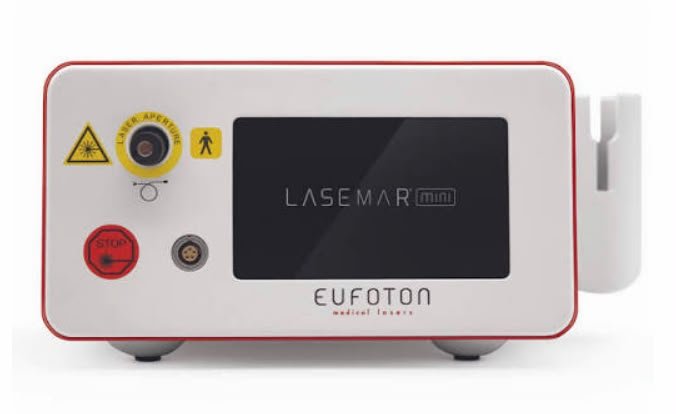
The 1940 nm wavelength represents the current generation of laser technology for soft tissue proctology. At this wavelength, the laser is absorbed with high selectivity by the target tissue — delivering precise thermal energy where it is needed while minimizing the effect on surrounding structures. This specificity is a significant part of why recovery is faster and post-procedure discomfort is lower than with older or less precisely calibrated systems.
In the United States, hemorrhoid surgery — traditional or laser — carries a significant price tag when paid out of pocket. Traditional hemorrhoidectomy commonly runs between $12,000 and $25,000, including surgeon fees, anesthesia, and facility charges. Laser proctology, where available in the US, is comparably priced and often harder to access, concentrated in a small number of specialized centers.
At Proctoclinic in Amman, the all-inclusive price for the LHP procedure is $1,200. A patient traveling from New York or Chicago — including return flights and a three-night hotel stay — typically spends approximately $3,000 in total. That compares to $12,000–$25,000 in the US, without the insurance complexity, the waiting lists, or the language barrier that many of our Arabic-speaking patients specifically want to avoid.
If there is one thing I wish I could tell patients earlier, it is this: home remedies do not resolve hemorrhoids. They manage symptoms. Witch hazel, sitz baths, dietary changes, over-the-counter creams — these can reduce discomfort in the short term, but they do not address the underlying vascular issue causing the hemorrhoid to enlarge.
What I see clinically, consistently, is that patients who delay treatment arrive with more advanced cases. Grade 2 hemorrhoids that were ignored for a year become Grade 3. Grade 3 becomes Grade 4. The condition that could have been resolved in a 15-minute procedure with three days of recovery becomes a more complex case requiring more intervention and a longer process.
“The right time to treat hemorrhoids is when they are bothering you — not when you have exhausted every other option first.”
Dr. Aref Hammam — Proctoclinic Jordan
There is also no merit in waiting for the pain to become unbearable before seeking help. Laser treatment is available now, at a fixed and transparent cost, with same-week scheduling. There is nothing to be gained by waiting — and something real to be lost by it.
For the majority of patients presenting with hemorrhoids of any grade, the answer is yes. At Proctoclinic, we evaluate each case individually before recommending a specific approach — but in practice, LHP is the right path for most patients we see, including those with Grade 4 hemorrhoids and those managing chronic conditions like diabetes or hypertension where minimizing surgical stress matters.
There are rare cases where traditional surgery remains the clinically appropriate choice — and when that is the case, we say so clearly. Our obligation is to the outcome, not to any particular technique. But those cases represent a small minority of what we see.
The starting point is a review of your medical history and current presentation. You can do that from wherever you are right now.
There is also no merit in waiting for the pain to become unbearable before seeking help. Laser treatment is available now, at a fixed and transparent cost, with same-week scheduling. There is nothing to be gained by waiting — and something real to be lost by it.
Send your medical report and our team will review your case and respond within 24 hours — with a clear treatment recommendation, a fixed cost quote, and no waiting list.
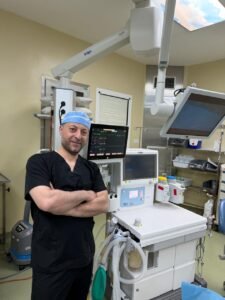
Laser Proctology Specialist — Proctoclinic, Amman, Jordan
Dr. Aref Hammam has practiced laser proctology exclusively for over 15 years, completing more than 8,500 laser procedures at Proctoclinic in Amman. He treats international patients from the United States, Europe, and across the Arab world, using the Eufoton Diode Laser (1940 nm) — the current generation of precision laser technology for anorectal care.
Advanced Laser Proctology · Amman
A specialist laser proctology clinic in Amman, Jordan. Serving international patients from the U.S., Europe, and the Arab world with minimally invasive anorectal care and same-week scheduling.
ISO 9001 Certified Clinic
9,000+ procedures completed
Jordan Trained Doctors
Lady doctor available for female patients
© 2026 Proctoclinic Jordan. All rights reserved.