
Reviewed within 24 hours
ISO 9001 Certified Clinic
A simple guide to piles (hemorrhoids) from a laser proctology specialist: what they are, how to tell if you have them, and what actually works.

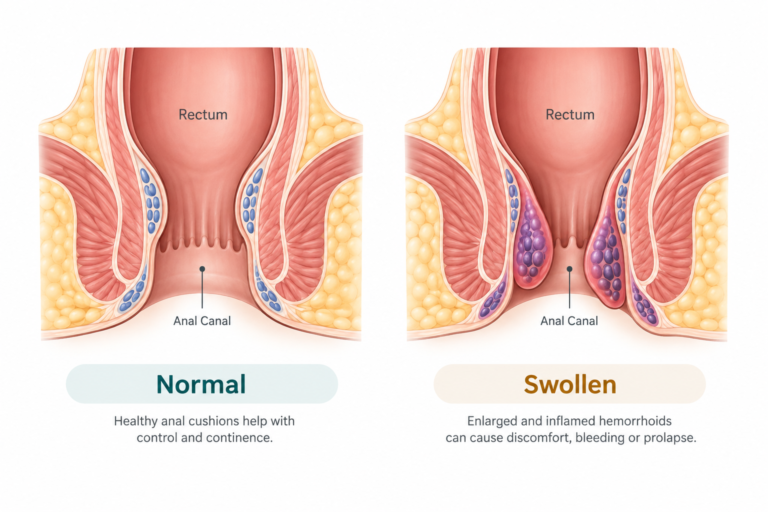
What are piles? Piles, called hemorrhoids in the United States, are swollen, inflamed veins and cushions of tissue in the lower rectum and around the anus. They are one of the most common reasons people see a proctologist, and one of the most delayed, because so many people are too embarrassed to ask.
I’m Dr. Aref Hammam. I have spent more than 15 years treating piles and other anorectal conditions with laser techniques. In this guide I’ll explain what piles are, what causes them, how to find out whether you really have them, and which treatments are worth considering, from simple home care to laser hemorrhoidoplasty.
Everyone is born with hemorrhoidal cushions. They are soft, blood-rich pads of tissue that help you control your bowels. They only become “piles” when they swell, stretch or slip out of place and start causing symptoms: bleeding, itching, pain, or a lump.
Piles are very common. In the US, an estimated 1 in 20 adults has bothersome hemorrhoids, and they become more common with age, affecting more than half of people over 50 (figures from Cleveland Clinic and NIDDK; see Sources).
Internal piles
Form inside the rectum. They usually cause painless bright-red bleeding rather than pain, because that part of the rectum has few pain nerves.
External piles
Form under the skin around the anus. They can itch, ache, and feel tender, especially when you sit.
Prolapsed piles
Internal piles that slip outside the anus. Some go back on their own, some you can push back, and some stay out.
Thrombosed piles
External piles where a blood clot has formed. The lump turns firm, purple or blue, and suddenly painful. The clot stays local and does not travel elsewhere in the body.
Doctors grade internal piles from I to IV. The grade matters more than almost anything else in choosing treatment.
Grade
I
II
III
IV
What is Happening
Swollen, but stays inside
Slips out when you strain, then returns by itself
Slips out and needs to be pushed back in
Stays out and cannot be pushed back
What you notice
Bleeding, no lump
Bleeding, occasional bulge
Regular bulge, mucus, irritation
Constant lump, discomfort, soilingOccasional rinse-off is usually enough
Starting Approach
Diet, fiber, sitz baths
Lifestyle first; office procedure or laser if it keeps happening
Procedure usually needed; laser hemorrhoidoplasty is an option
Usually needs a procedure; assessed case by case
Grading is done by examination. Do not self-grade from the table.
Piles are caused by too much pressure on the veins in and around the rectum, over and over. The most common contributors:
Most people have more than one of these. That’s good news, because it means there is usually something you can change.
Symptoms depend on the type:
What piles do not typically cause: unexplained weight loss, black or tarry stools, blood mixed through the stool, or a lasting change in your bowel habits. If you have any of these, see a doctor rather than assuming it’s piles.
The short answer: You can suspect piles at home, but you can only confirm them with an examination. Many conditions look and feel similar.
1
Notice the pattern. Painless bright-red blood on the paper points toward internal piles. A tender lump or itching around the anus points toward external piles. Sharp, tearing pain during a bowel movement points away from piles and toward a fissure.
2
Know what you can’t tell at home. You can’t judge the grade, can’t see inside the rectum, and can’t tell piles from skin tags, fissures, fistulas or other causes of bleeding.
3
Get examined. A specialist can usually confirm piles in a short visit:
4
Colonoscopy when it’s warranted. If you have bleeding and are 45 or older (the age US guidelines recommend starting colorectal cancer screening), have blood mixed in the stool, iron-deficiency anemia, a change in bowel habits, or a family history of bowel cancer, you may need a colonoscopy or sigmoidoscopy as well, so nothing serious is missed.
Not able to travel or visit yet? Send us your history and any reports you already have through our online consultation. Every submission is reviewed personally within 24 hours, in Arabic or English, with no obligation. This helps you understand your options, but a diagnosis and treatment plan still need an in-person exam.
Condition
Piles
Anal fissure
Anal fistula
Pilonidal sinus
Typical clue
Painless bright-red bleeding, or a soft lump or itching at the anus
Sharp, tearing pain during or after a bowel movement, small streak of blood
Recurring discharge or pus near the anus, a boil that keeps coming back
Painful swelling or drainage at the top of the buttock crease, near the tailbone (not at the anus)
Where to learn more
This page
The short answer: Usually not. Piles are not cancer and do not turn into cancer. But they can be uncomfortable enough to disrupt your life, and the symptoms overlap with more serious conditions, so bleeding should always be checked at least once.
Go to urgent or emergency care for heavy bleeding that will not stop, dizziness or fainting, or severe pain with fever.
The short answer: You can usually calm a flare-up within a few days and settle it within about a week. You cannot shrink piles overnight, and anything that promises to is overselling. This is the first-week plan I give patients:
1
Warm sitz bath. Sit in a few inches of warm (not hot) water for 10 to 15 minutes, up to 2 to 3 times a day and after bowel movements. This eases spasm and pain.
2
Soften the stool. Aim for about 25 g of fiber a day for women and 38 g for men (fruit, vegetables, beans, oats, whole grains), or use a psyllium fiber supplement. Drink water through the day.
3
Stop straining. Go when you feel the urge. Don’t sit longer than about 5 minutes and leave the phone outside.
4
Use a short-term cream. Over-the-counter creams with witch hazel, lidocaine or 1% hydrocortisone can ease itching and pain. Don’t use hydrocortisone longer than 7 days unless a doctor says so.
5
Clean gently. Use water or unscented wet wipes and pat dry. Avoid scrubbing and perfumed products.
6
Be careful with pain relievers. Acetaminophen (Tylenol) is usually a safe first choice. If you are bleeding, ask a pharmacist before taking ibuprofen or aspirin. Avoid opioid painkillers if you can, because they cause constipation.
7
Avoid heavy lifting for a few days.
When quick fixes are not enough: If there’s no improvement after a week, if piles keep coming back or slipping out, or if bleeding continues, home care is not going to solve the underlying problem. It’s time to see a specialist. For more detail, read our guide on how to cure piles at home and what shrinks piles quickly.
No single treatment is best for everyone. The right one depends on your grade, whether the problem is internal, external or both, your health, and how much downtime you can afford.
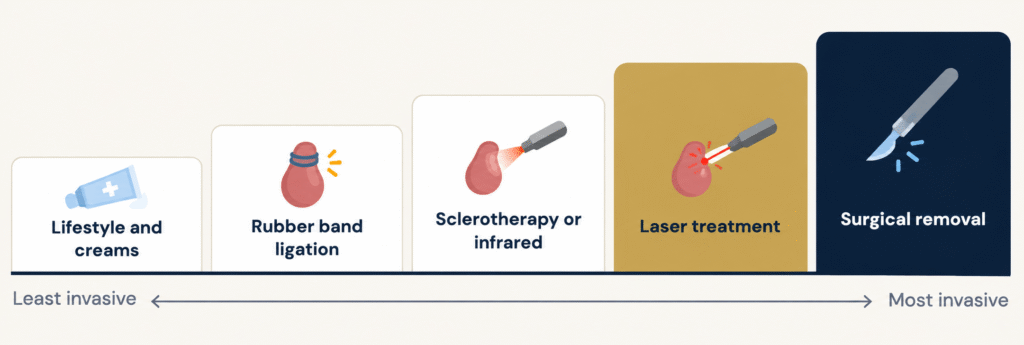
Condition
Lifestyle + creams
Rubber band ligation
Sclerotherapy / infrared coagulation
Laser hemorrhoidoplasty (LHP)
Hemorrhoidectomy (surgical removal)
Other surgical options (stapling, THD/HAL-RAR)
How it works
Softer stool, less pressure
A band cuts off the blood supply of an internal pile
Injection or heat shrinks the pile
A thin laser fiber delivers energy inside the pile so it shrinks and settles back into place, without cutting
The pile is cut away
Repositions or reduces blood flow to the pile
Usually suits
This page
Internal grade I–III
Small internal piles
Grade II–III, and selected grade IV
Large, advanced or mixed piles
Selected grade II–III
Downtime
This page
Little
Minimal
Usually days, not weeks
Often 2–4 weeks
Varies
Trade-offs
This page
May need repeat sessions; can cause cramping or bleeding when the pile drops off
Less durable for larger piles
Needs an exam to confirm suitability; a large external skin component may need separate treatment
Most durable option for advanced disease, but the most painful recovery
Not available everywhere; results depend on techniqueMost durable option for advanced disease, but the most painful recovery
At Proctoclinic I treat internal piles with laser hemorrhoidoplasty using a Eufoton diode laser (1940 nm, made in Italy). In simple terms, a slim fiber delivers focused laser energy inside the swollen tissue. The pile shrinks and tightens, and there are no incisions and no open wounds.
What patients value most:
I want to be straightforward: laser is not right for every case, and it is not magic. If your exam shows that another approach suits you better, I’ll tell you. See our detailed recovery guide, and how laser compares with traditional hemorrhoid surgery.
Piles can be treated very effectively, but no treatment can honestly promise “100%, never again.”
Here is why. Everyone has hemorrhoidal cushions, so the goal is not to remove a disease, it is to eliminate the swollen, symptomatic piles and reduce the reasons they swelled in the first place.
I’d be cautious about any clinic that promises a guaranteed permanent cure. What I can promise is a proper diagnosis, an honest recommendation, and a plan to lower your chance of recurrence: fiber, hydration, and habits. Follow-up matters too.
Many of my patients come from Arabic-speaking communities in New York, Chicago and elsewhere in the US. Some have been told to wait months for a specialist appointment. Some just want a specialist who speaks their language and treats them without embarrassment. If that sounds like you, here is how it works:
1
Send your case. Share your symptoms and any reports through the online consultation. We respond within 24 hours in Arabic or English.
2
Eligibility is confirmed. If laser treatment looks suitable, we plan dates. If you need a local evaluation first (for example, heavy bleeding or a suspected bowel problem), I’ll say so. Your safety comes before the trip.
3
Travel and treatment. Treatment itself is a same-day procedure. Most international patients stay in Jordan about three days, depending on recovery and travel plans.
4
Follow-up at home. After you fly back, we stay in touch with remote follow-up.
Not sure what to expect? Read our medical travel guide for Jordan, our pages for New York and Chicago, and our US hemorrhoid specialist page. Patients who want to compare how treatment abroad stacks up against US out-of-pocket prices can see it on our cost comparison page.
Arabic-speaking readers: see our Arabic guide for patients in the US.
Piles are not the only cause of pain, bleeding or a lump near the anus. We treat these conditions with the same minimally invasive laser approach:
Common Questions
Yes. “Piles” is the older and more common term in the UK, the Middle East and South Asia. “Hemorrhoids” is the usual term in the US. They describe the same swollen tissue.
Small, mild piles often settle within a week or so with fiber, water, sitz baths and no straining. Piles that keep prolapsing, keep bleeding or keep coming back usually need a specialist.
Focus less on a “banned list” and more on fiber. Low-fiber, refined foods and dehydration make stools hard. Some people find that heavy alcohol, very spicy food or a lot of cheese and red meat makes their symptoms worse. If a food seems to trigger yours, cut back and see.
No. Piles are not cancerous and do not become cancer. However, colorectal cancer can cause rectal bleeding that looks like piles, which is why first-time or persistent bleeding, especially after 45, should be checked.
The procedure is done under anesthesia chosen by the surgeon, so you should feel no pain during it. Afterward most patients describe mild discomfort that is generally less than after open surgery, though everyone is different.
Most patients are cleared to travel within a few days, once the surgeon confirms the recovery is on track. On the flight, walk regularly, drink water, eat fiber, and avoid long stretches of sitting. Your surgeon will give you personal advice.
Send us your case and I’ll review it personally. You’ll hear back within 24 hours, in Arabic or English, with no obligation.
This article is for education only and does not replace an examination or personal medical advice.

Advanced Laser Proctology · Amman
A specialist laser proctology clinic in Amman, Jordan. Serving international patients from the U.S., Europe, and the Arab world with minimally invasive anorectal care and same-week scheduling.
ISO 9001 Certified Clinic
9,000+ procedures completed
Jordan Trained Doctors
Lady doctor available for female patients
© 2026 Proctoclinic Jordan. All rights reserved.