
Reviewed within 24 hours
ISO 9001 Certified Clinic
Painless bleeding, a bulge that won’t stay put, or an internal hemorrhoid that keeps coming back? Here’s how we diagnose and treat internal hemorrhoids with laser hemorrhoidoplasty, no incisions, same-day discharge.
Internal hemorrhoids treatment starts with knowing what you’re actually dealing with. Internal hemorrhoids are swollen cushions of tissue inside the rectum, above the point where the lining becomes sensitive skin, which is why they usually bleed without hurting. That’s also why they’re easy to ignore until they start prolapsing, bleeding more, or interfering with daily life.
I’m Dr. Aref Hammam. At Proctoclinic I treat internal hemorrhoids with laser hemorrhoidoplasty, a technique that shrinks the swollen tissue from the inside using a diode laser fiber, with no incisions and same-day discharge. On this page: how to recognize internal hemorrhoids, how we grade them, when laser treatment fits, and what to expect if you come to us.
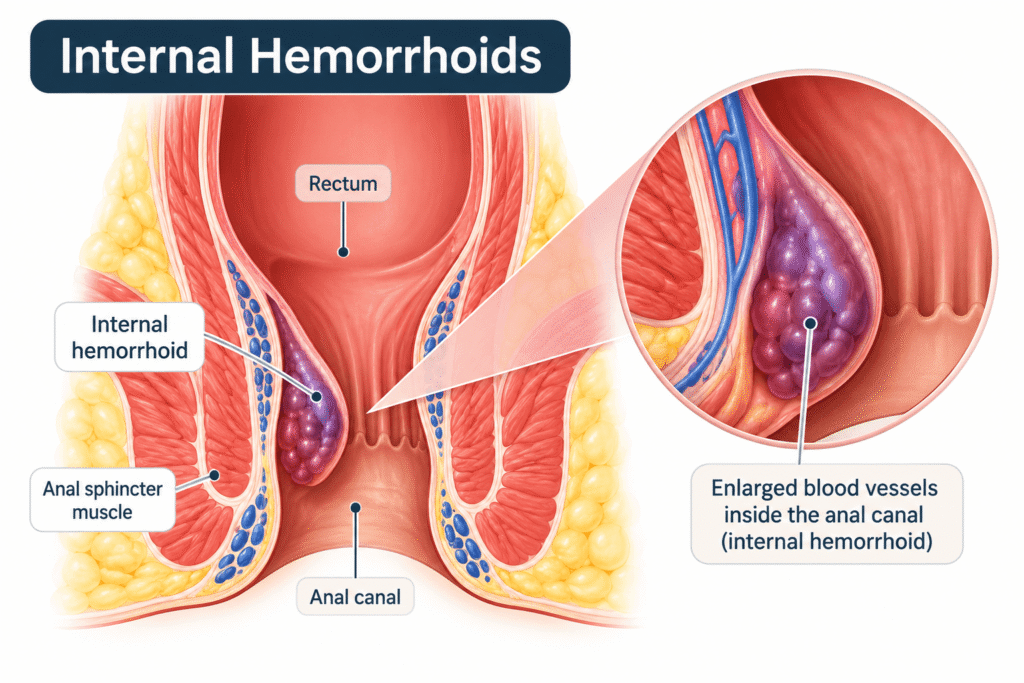
Internal hemorrhoids form above the dentate line, the point inside the anal canal where the lining changes from internal rectal tissue to the more sensitive skin around the anus. Because that inner tissue has very few pain nerves, internal hemorrhoids typically cause bleeding rather than pain, at least until they prolapse (slip downward or outward).
Everyone has hemorrhoidal cushions; they only become “hemorrhoids” as a condition when they swell, stretch or slip out of place and start causing symptoms. For the broader picture, including external and thrombosed hemorrhoids, see our full guide to what piles are, causes and treatment.
The most common symptoms of internal hemorrhoids are:
What internal hemorrhoids don’t typically cause: sharp pain during bowel movements (more typical of a fissure), a hard painful lump that appeared suddenly (more typical of a thrombosed external hemorrhoid), or unexplained weight loss. If you notice any of these, or bleeding that is heavy, dark, or mixed into the stool rather than on its surface, see a doctor rather than assuming it’s a hemorrhoid.
Not sure these symptoms match what you’re experiencing? Our guide on how to confirm if you have piles walks through what you can assess at home versus what needs an exam.
Internal hemorrhoids are graded I to IV based on how far they prolapse. The grade is the single biggest factor in choosing treatment.
| Grade | What’s happening | Typical approach |
|---|---|---|
| I | Swollen, stays inside the rectum | Diet, fiber, sitz baths |
| II | Prolapses with straining, returns on its own | Lifestyle first; laser if it recurs |
| III | Prolapses, needs to be pushed back in | Laser hemorrhoidoplasty is a strong fit |
| IV | Stays prolapsed, can’t be pushed back | Usually needs a procedure; assessed individually |
Grading requires an examination. For the full breakdown with illustrations, see the grades section of our piles guide.
Internal and external hemorrhoids are both swollen hemorrhoidal tissue, but their location changes how they feel and how urgently they need attention.
| Internal hemorrhoids | External hemorrhoids | |
|---|---|---|
| Location | Inside the rectum, above the dentate line | Under the skin around the anus |
| Pain | Usually painless unless prolapsed | Can itch, ache, or feel tender, especially sitting |
| Bleeding | Common, bright red | Less common unless thrombosed |
| Visible/felt? | Only if prolapsed | Usually yes, as a lump |
| Main risk | Prolapse, anemia from chronic bleeding | Thrombosis (a sudden painful clot) |
Many patients have both internal and external components at once. If your symptoms sound more like the external column, see our dedicated external hemorrhoids treatment page.
For referring physicians, insurers, or patients looking this up for their own records, internal hemorrhoids fall under ICD-10 category K64 (hemorrhoids and perianal venous thrombosis):
| Code | Description |
|---|---|
| K64.0 | First degree hemorrhoids (Grade I) |
| K64.1 | Second degree hemorrhoids (Grade II) |
| K64.2 | Third degree hemorrhoids (Grade III) |
| K64.3 | Fourth degree hemorrhoids (Grade IV) |
| K64.8 | Other hemorrhoids |
| K64.9 | Unspecified hemorrhoids |
Provided for reference only; not a substitute for coding by a treating clinician.
How to treat internal hemorrhoids depends almost entirely on the grade and how much it’s affecting your life.
| Option | Best for | Downtime |
|---|---|---|
| Fiber, hydration, sitz baths | Grade I–II, mild cases | None |
| Rubber band ligation | Grade I–III | Little |
| Laser hemorrhoidoplasty | Grade I–IV | Days, not weeks |
| Surgical hemorrhoidectomy | Large or advanced disease | 2–4 weeks |
We treat internal hemorrhoids with a Eufoton diode laser (1940nm, Italy). A thin fiber delivers laser energy directly into the swollen tissue, which shrinks and settles back into place. There are no incisions, and the whole visit, from admission to discharge, takes around three hours.
Laser isn’t right for every case. If your exam points to a different approach, I’ll tell you directly. See our recovery guide and how laser compares with traditional surgery.
1
Send your case.
Share your symptoms through our online consultation. We reply within 24 hours, in Arabic or English.
2
Get an exam.
We confirm the grade and whether laser is the right fit, in person at the clinic.
3
Same-day treatment.
Laser hemorrhoidoplasty is typically done the same day as your exam, with same-day discharge.
4
Follow-up.
We check on your recovery and stay reachable remotely once you’re home.
Traveling from the US? See our medical travel guide to Jordan for visas, flights and what your trip looks like day by day.
Common Questions
They can be treated very effectively; banding, laser and surgery can all resolve the hemorrhoids that were treated. But since everyone has hemorrhoidal tissue, new hemorrhoids can form again if the underlying causes, like straining or chronic constipation, aren’t addressed. No treatment can honestly promise they’ll never return.
For mild, Grade I–II hemorrhoids: more fiber, more water, sitz baths, and avoiding straining or long toilet sits, usually within about a week. For hemorrhoids that keep prolapsing, bleeding, or don’t respond to home care, a procedure like laser hemorrhoidoplasty is usually the next step.
Mild flare-ups treated with home care typically settle within about a week. After laser hemorrhoidoplasty, most patients are back to light daily activity within a few days, with fuller recovery over the following one to two weeks. Your surgeon will give you a timeline specific to your case.
Usually not. They’re not cancerous and don’t become cancer. But chronic bleeding can lead to anemia, and a prolapsed hemorrhoid can become strangulated (its blood supply cut off) in rare cases. Bleeding should always be checked, especially if it’s your first time noticing it or you’re over 45.
The underlying laser technique is similar, but the approach differs by location: internal hemorrhoids are treated from inside the rectum, with the main goal of shrinking and repositioning the tissue, while external hemorrhoids involve tissue under the skin that may need separate attention. See our external hemorrhoids page for that side of it.
Send us your symptoms and I’ll review your case personally. You’ll hear back within 24 hours, in Arabic or English, with no obligation.
This page is for education only and does not replace an examination or personal medical advice.
Advanced Laser Proctology · Amman
A specialist laser proctology clinic in Amman, Jordan. Serving international patients from the U.S., Europe, and the Arab world with minimally invasive anorectal care and same-week scheduling.
ISO 9001 Certified Clinic
9,000+ procedures completed
Jordan Trained Doctors
Lady doctor available for female patients
© 2026 Proctoclinic Jordan. All rights reserved.