
Reviewed within 24 hours
ISO 9001 Certified Clinic
Noticed bleeding, a bulge, or discomfort after a heavy lift? Here’s what actually causes hemorrhoids in gym-goers, which exercises and supplements make them worse, what helps, and when it’s time to get checked.

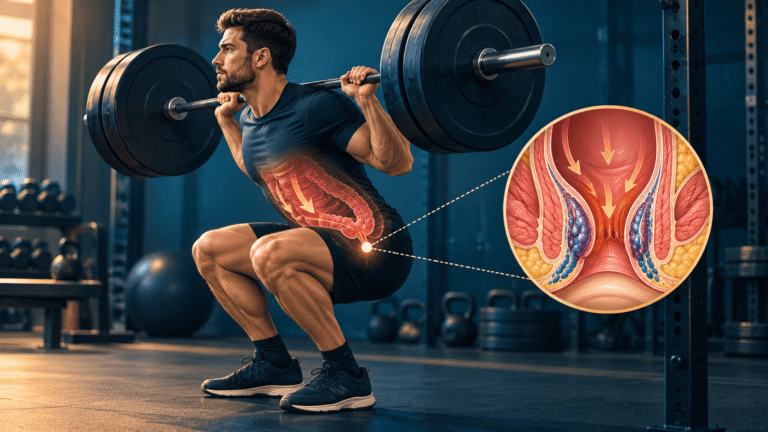
Hemorrhoids from weightlifting are more common than most gym-goers realize, and most people only search for this once symptoms have already started: bleeding after a heavy set, a lump that wasn’t there before, or discomfort that lingers after leg day. If that’s you, you’re not alone, and this isn’t something you caused by “doing something wrong” at the gym. It’s usually a mix of lifting technique, diet, and hydration that’s fixable.
I’m Dr. Aref Hammam. I treat piles and hemorrhoids regularly in active, fit patients, not just people with sedentary lifestyles. This page covers why heavy training can trigger hemorrhoids, which exercises and supplements tend to make things worse, what actually helps, and how to know when it’s time to stop self-managing and get examined.
Hemorrhoids form when the veins in and around the rectum come under repeated, excess pressure. For gym-goers, that pressure usually comes from a combination of these:
None of this means you need to stop training. It means the way you lift, eat, and hydrate matters more once hemorrhoids are in the picture. For the fuller medical picture of what piles are and how they’re graded, see our complete guide to piles.
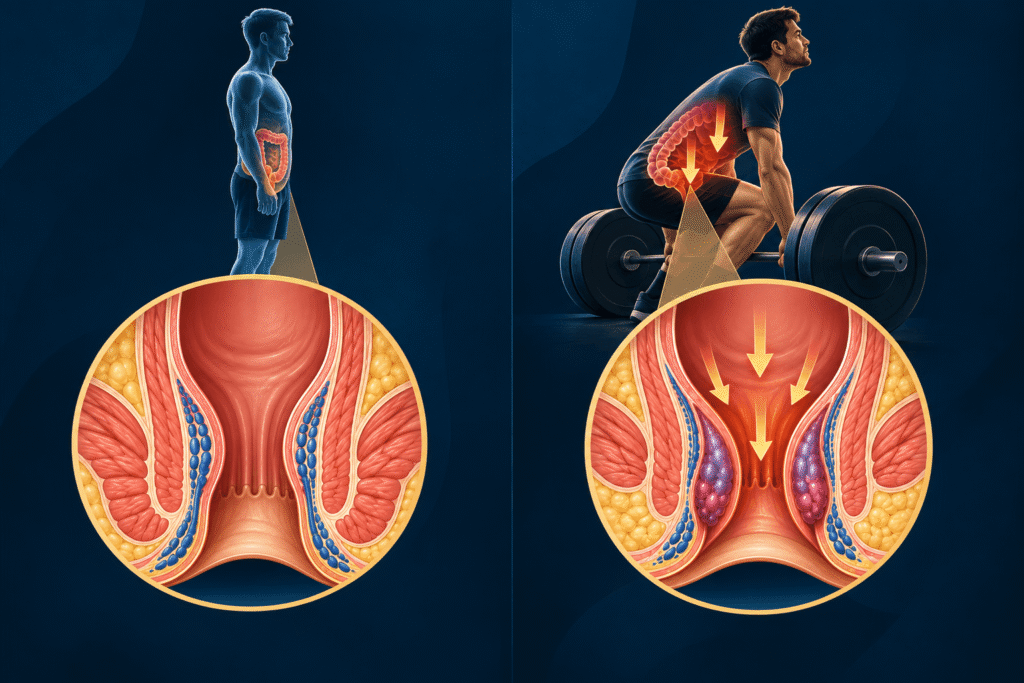
If you’re reading this because something feels off after a workout, here’s what typically points to hemorrhoids (piles):
Don’t assume it’s piles if: the pain is a sharp, tearing sensation during the bowel movement itself rather than after (more typical of an anal fissure, which heavy straining can also cause), or if you notice unexplained weight loss, dark or tarry stool, or blood mixed into the stool rather than on its surface. Those need a doctor’s look regardless of your training.
Not sure how your symptoms line up? Our guide on how to confirm if you have piles breaks down what you can assess yourself versus what needs an exam.
You usually don’t need to stop training altogether, just adjust what you’re doing while symptoms are active.
Once symptoms settle, most people can return to heavier lifting gradually, with the technique changes below.
1
Breathe, don’t hold.
Exhale through the hardest part of the lift instead of holding your breath and bearing down. Some lifters use controlled breathing techniques for heavy lifts; ask a coach to check your technique if you’re not sure yours is safe.
2
Progress gradually.
Jumping to weights your body isn’t ready for is one of the most common triggers. Build up load over weeks, not within a single session.
3
Keep your spine neutral
and your core braced without excessive downward straining.
4
Don’t rush your warm-up.
Lifting heavy cold increases the chance of poor form and excess straining.
5
Take breaks from sitting
between sets rather than staying seated on a bench the whole time.
Most gym supplements are fine for your digestion. A few are genuinely worth watching, and a few get blamed more than the evidence supports. Here’s how they break down:
| Supplement | What we actually know | What to do |
|---|---|---|
| Iron (in multivitamins or standalone) | One of the best-documented causes of constipation, gym-goer or not. | Only supplement iron if you actually need it; pair with fiber and water; ask about a gentler form if it’s prescribed. |
| Calcium (and calcium-based antacids) | Also well-documented as constipating, especially at high doses. | Avoid stacking multiple calcium sources (multivitamin + antacid + dairy-heavy diet) without spreading them out. |
| Whey protein (concentrate especially) | Can cause constipation or bloating in some people, often linked to lactose content rather than the protein itself. | If shakes seem to bother you, try a whey isolate (lower lactose) or a plant-based protein, and make sure fiber intake goes up alongside protein, not down. |
| Creatine monohydrate | At standard doses (3–5g/day) the evidence doesn’t show a strong direct link to constipation; reported cases are more often tied to low water intake or other dietary changes happening at the same time. | Take with adequate water; don’t “dry scoop”; if symptoms start, look at your whole diet and hydration before assuming it’s the creatine. |
| B-complex and Vitamin E | No strong evidence linking standard doses to constipation or hemorrhoids specifically. | Generally fine at recommended doses; megadosing any supplement without a clear reason is worth avoiding regardless. |
| Fiber supplements (psyllium, etc.) | Well-supported for easing and preventing the straining that aggravates hemorrhoids. | A reasonable addition if your diet runs low on fiber, especially during a high-protein phase. |
This isn’t a complete list of every supplement. If you’re taking a pre-workout, mass gainer, or stack with multiple ingredients, check the label for added iron or calcium, which is where most of the real risk tends to hide.
Supplements aside, the most common dietary driver we see is simple: more protein, less fiber. A bulking or cutting phase heavy in meat, eggs, and shakes, with fewer whole grains, vegetables, fruit, and legumes, is a reliable recipe for harder stool and more straining. Adding fiber back in usually matters more than cutting any single supplement.
Yes. Dehydration is one of the more underrated contributors to hemorrhoids in gym-goers. Less water means harder stool, which means more straining, whether you train or not.
Training increases your fluid needs beyond daily baseline, especially in a hot gym or on cardio days. If you use creatine, protein, or any other supplement that increases your fluid needs, treat water intake as part of the supplement protocol, not an afterthought. A practical marker: pale yellow urine is a reasonable sign you’re keeping up.
Most mild, gym-related flare-ups settle within about a week with the changes above: more fiber, more water, easing off heavy straining lifts, and a warm sitz bath for symptom relief. If that’s not happening, it’s worth getting examined rather than continuing to guess.
If symptoms are recurring enough to keep shaping your training around them, a short in-clinic procedure may solve the problem faster than months of working around it. We treat internal and external hemorrhoids with laser hemorrhoidoplasty, no incisions, same-day discharge, so most patients are back to light training within days. See our internal hemorrhoids treatment page or external hemorrhoids treatment page for what that involves.
Common Questions
Often yes, with changes: ease off heavy straining lifts, switch to lighter loads or bodyweight work, and focus on breathing instead of holding your breath. If a lift consistently triggers symptoms, treat that as a sign to back off that specific movement for now, not to stop training altogether.
Straining while holding your breath during heavy lifts, known as the Valsalva maneuver. It’s a normal bracing technique in moderation, but overused or combined with poor form, it’s the most consistent gym-specific trigger.
Not directly. Some protein powders, especially whey concentrate, can cause constipation in people sensitive to lactose, and constipation is what actually drives hemorrhoid flare-ups through straining. Pairing protein intake with enough fiber and water usually resolves it.
Not necessarily. At standard doses, the evidence doesn’t strongly support creatine itself as a direct cause of constipation. Check your overall water intake and fiber first before cutting it.
It’s common enough that it shouldn’t cause panic, but it’s not something to ignore either. Painless bright red bleeding after straining usually points to hemorrhoids. If it continues beyond a week of easing off heavy lifting and adding fiber and water, get it examined.
Active, fit patients are sometimes the most surprised to end up in my clinic for piles. It’s not a sign you’re doing something wrong in life, it’s usually a straightforward mechanical and dietary issue that responds well to the right changes, or to a short procedure if it keeps coming back.
Dr. Aref Hammam
Lead Laser Proctology Surgeon, Proctoclinic, Amman
Send us your symptoms and I’ll review your case personally. You’ll hear back within 24 hours, in Arabic or English, with no obligation.
This page is for education only and does not replace an examination or personal medical advice. If you’re experiencing symptoms, this article’s content shouldn’t delay a proper evaluation.

Advanced Laser Proctology · Amman
A specialist laser proctology clinic in Amman, Jordan. Serving international patients from the U.S., Europe, and the Arab world with minimally invasive anorectal care and same-week scheduling.
ISO 9001 Certified Clinic
9,000+ procedures completed
Jordan Trained Doctors
Lady doctor available for female patients
© 2026 Proctoclinic Jordan. All rights reserved.