
Reviewed within 24 hours
ISO 9001 Certified Clinic

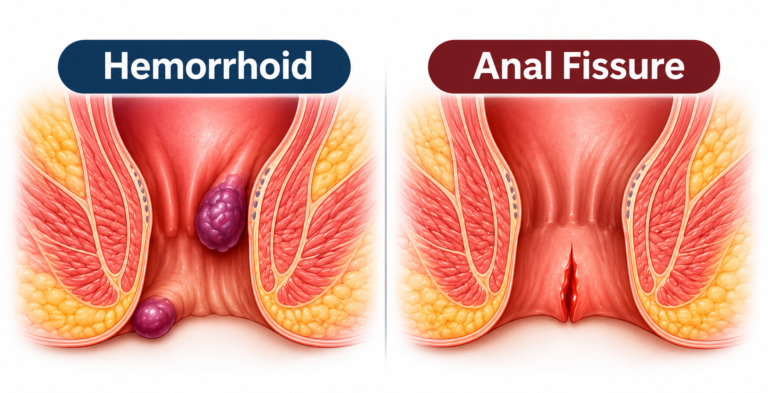
An anal fissure is a small tear in the lining of the anal canal. A hemorrhoid is a swollen blood vessel in or around the anus. Both can cause pain and bleeding, causing confusion about the condition, but the two have different causes, different symptom patterns, and need different treatment.
| Feature | Anal Fissure | Hemorrhoid |
|---|---|---|
| What it is | A small tear in the anal lining | A swollen blood vessel in or around the anus |
| Pain | Sharp, cutting, “like passing glass” | Dull ache or pressure, often painless (internal) |
| When it hurts | During and after bowel movements, can last hours | Variable; thrombosed hemorrhoids cause constant pain |
| Bleeding | Bright red streaks on paper or stool, with pain | Bright red, often painless, can be heavier |
| Visible lump | Usually none; sometimes a small skin tag | Often yes, especially external hemorrhoids |
| Itching | Less common | Common |
An anal fissure is a small, linear tear in the anoderm; the thin, sensitive skin lining the anal canal. It’s most often caused by passing a hard or large stool, which stretches and tears the tissue. Once it happens, the pain can trigger the anal sphincter muscle to spasm, which makes the area harder to heal and often causes pain to linger well after the bowel movement ends.
A hemorrhoid is a swollen vein, either inside the anal canal (internal) or under the skin around the anus (external). They develop from increased pressure in that area — most commonly from straining, chronic constipation, pregnancy, or prolonged sitting. Internal hemorrhoids often cause painless bleeding, while external hemorrhoids can cause itching, discomfort, or a noticeable lump. If a blood clot forms in an external hemorrhoid (a thrombosed hemorrhoid), pain can become sudden and severe.
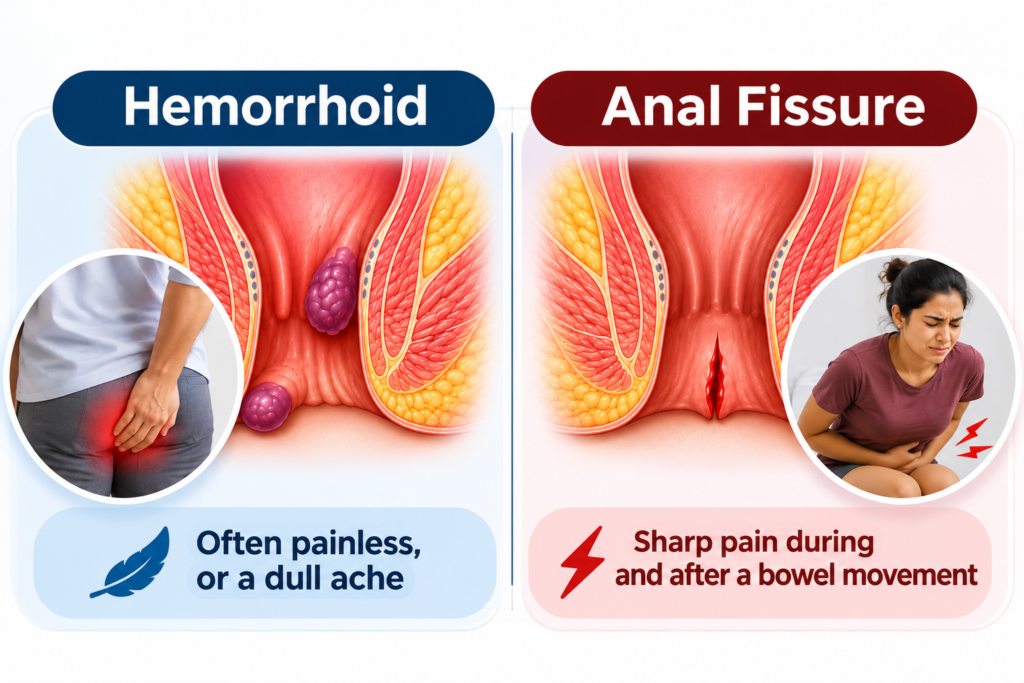
While only an exam can confirm it, a few patterns offer a strong clue:
This is a useful starting point, not a diagnosis. Symptoms genuinely overlap in some cases, which is exactly why guessing isn’t reliable.
Yes, and it’s more common than people expect. Fissures and hemorrhoids share a root cause. Straining from hard stools or constipation, so the same habits that lead to one often contribute to the other. When that happens, the symptom picture gets genuinely confusing: you might have bleeding from a hemorrhoid and sharp pain from a fissure at the same time, with no clean way to separate them without an exam.
See a doctor promptly if: bleeding is heavy, you feel faint, pain is severe and worsening, or symptoms persist beyond seven days despite home care. Dark, maroon, or black stool is a different concern and shouldn’t be assumed to be a fissure or hemorrhoid.
Fissures and hemorrhoids aren’t treated the same way, which is exactly why getting the right diagnosis matters:
Treating a fissure like a hemorrhoid, or vice versa, generally doesn’t resolve the actual problem, which is part of why self-treating based on a guess often doesn’t work.
If diet and lifestyle changes are your first step either way, start here: How to Manage Hemorrhoids at Home →
Give conservative care: fiber, water, avoiding straining, about 1–2 weeks. If pain is severe from the start, bleeding is more than light spotting, or nothing improves in that window, it’s worth getting an actual exam rather than continuing to guess.
Worth knowing if you’re in the US: many patients face a 4–6 month wait for a colorectal consult. That’s a long time to live with pain you can’t confidently identify, let alone treat correctly. If you’ve tried the basics and symptoms persist, it’s worth knowing faster evaluation and treatment options exist.
Submit your case and photos if comfortable, and our team will help identify what you’re dealing with and the right next step — within 24 hours, no obligation.
Yes, easily. Both can cause bleeding and discomfort in the same area. The pain pattern is usually the clearest clue: sharp, tearing pain during and after a bowel movement points to a fissure, while painless bleeding or a dull ache points to a hemorrhoid.
Anal fissures are generally more painful. The pain is sharp and knife-like, and can last minutes to hours after a bowel movement. Hemorrhoid pain, when present, is usually a duller ache, except for a thrombosed hemorrhoid, which can cause sudden, intense pain.
Yes. Both share a common cause: straining from constipation. so it’s common to develop both at once, which is part of why self-diagnosis isn’t reliable.
This article is for general information and isn’t a substitute for medical advice. Proctoclinic · Amman, Jordan. Medically reviewed by Dr. Aref Hammam, last reviewed October 2026.
Sources
Advanced Laser Proctology · Amman
A specialist laser proctology clinic in Amman, Jordan. Serving international patients from the U.S., Europe, and the Arab world with minimally invasive anorectal care and same-week scheduling.
ISO 9001 Certified Clinic
9,000+ procedures completed
Jordan Trained Doctors
Lady doctor available for female patients
© 2026 Proctoclinic Jordan. All rights reserved.