
Reviewed within 24 hours
ISO 9001 Certified Clinic
Anal fistulas rarely get better on their own, and the pain is often worse than people expect from something they have never heard of before their own diagnosis. Here is what causes them, how to recognize one, and why laser treatment has become a preferred option for many patients.

If you are researching laser treatment for anal fistulas, you are probably dealing with one of two situations. Either you already have a diagnosis and you are trying to understand your options, or you have symptoms that sound uncomfortably close to what is described here and you have not seen a doctor yet. This guide is written for both.
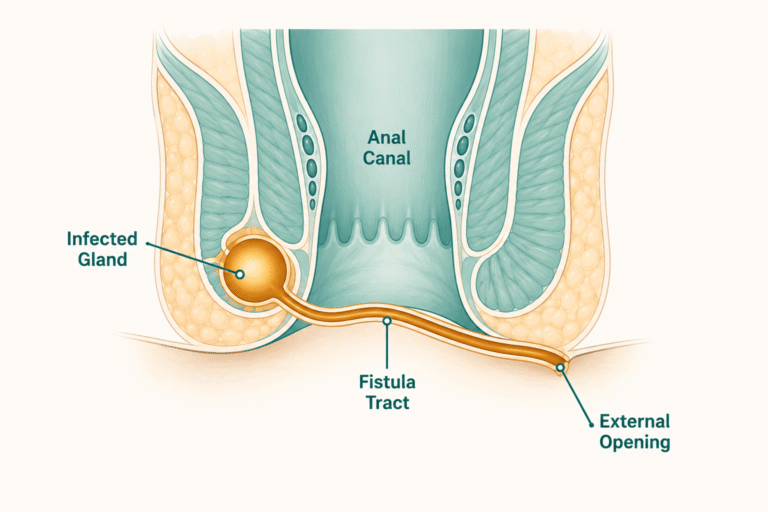
An anal fistula is not the same thing as a hemorrhoid, and it does not usually get better with home care the way a mild hemorrhoid flare-up can. It is a small tunnel that forms between the inside of the anal canal and the skin outside, almost always as a result of an infection that needed somewhere to drain. Left alone, it tends to keep draining, keep hurting, and keep coming back until it is properly treated.
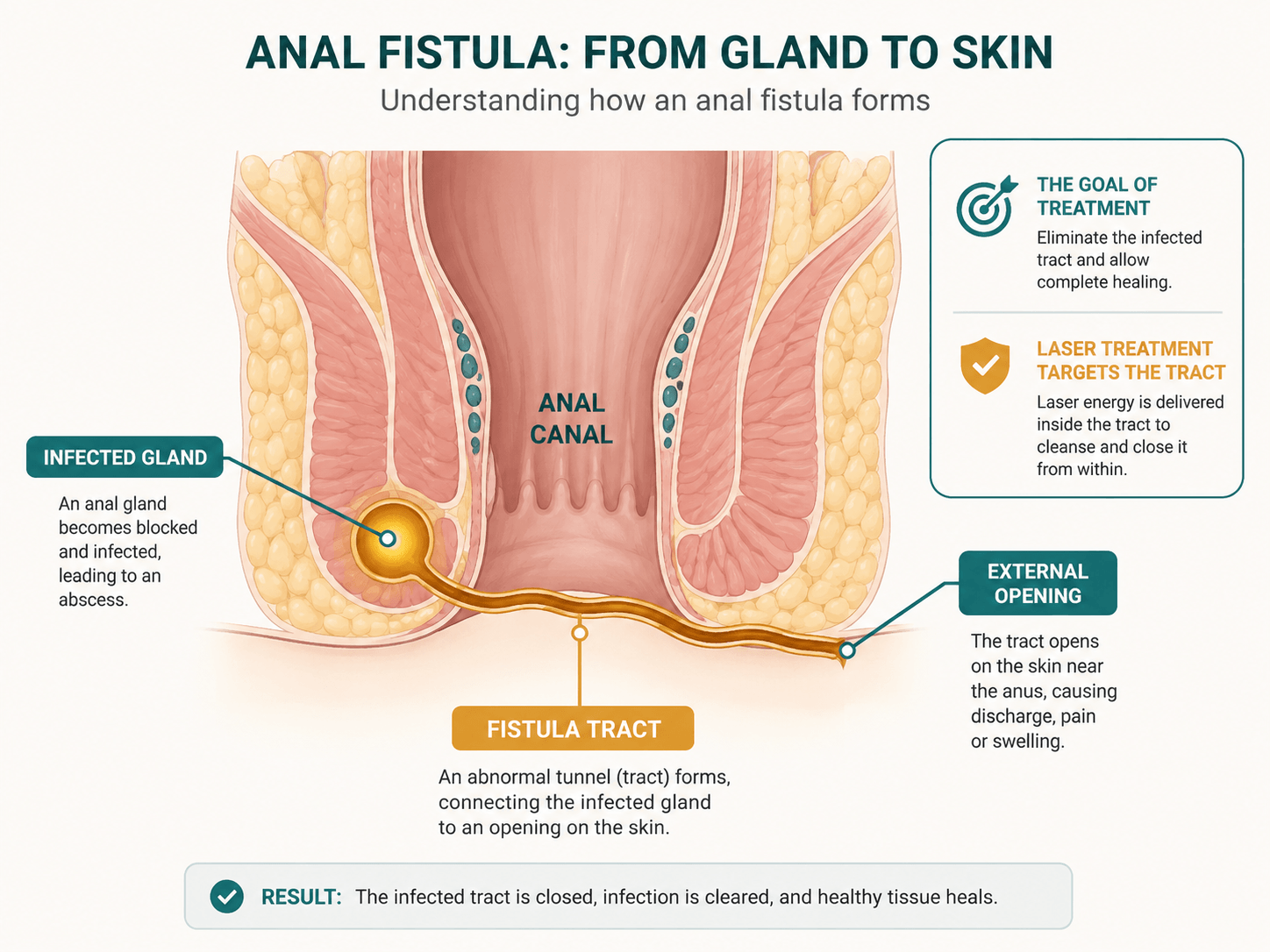
Inside the anal canal, small glands sit just under the surface. When one of these glands becomes infected, it can form an abscess, which is simply a pocket of pus that needs to drain somewhere. Sometimes that drainage happens through a channel the body creates on its own, or through a small incision a doctor makes to relieve the infection. When that drainage path does not fully close afterward, it leaves behind a lasting tunnel between the inside of the anus and the skin outside. That tunnel is the fistula.
It is a genuinely common condition, and it affects men roughly twice as often as women. Most cases trace back to an infected anal gland, and the majority of fistulas begin as an abscess that needed to drain in the first place.
Anal fistula symptoms tend to be hard to ignore, which is part of why most people end up seeking treatment fairly quickly once they appear:
Some people can see or feel a small opening near the anus, while others cannot, especially if the outer opening has temporarily closed while the tunnel underneath is still there. A fistula that seems to heal at the surface but keeps returning is a very typical pattern, not a sign that anything unusual is happening with your body specifically.
The most common cause by far is a perianal abscess, an infected gland that formed a pocket of pus needing to drain. In most cases, this accounts for the large majority of anal fistulas. Less commonly, fistulas can develop because of:
Men are more likely to develop fistulas than women, and anyone with a history of a perianal abscess, Crohn’s disease, or a weakened immune system has a higher likelihood of developing one.
A fistula that seems to close on the surface is not the same as a fistula that has healed.
Most anal fistulas can be identified during a physical examination. Finding the internal opening, inside the anal canal, sometimes takes more work, and in some cases requires a lighted scope or an injection of a solution that helps highlight the tract. If the area is too painful to examine while awake, this step may be done under sedation.
Depending on the complexity of the fistula, your doctor may also order imaging such as an MRI, an endoanal ultrasound, or a fistulogram, which is an X-ray taken after dye is injected into the fistula tract. These tests help map exactly where the tunnel goes and how close it runs to the muscles that control bowel movements, which matters a great deal for planning treatment.
Almost all anal fistulas eventually need some form of procedure to resolve, since they rarely close permanently on their own. The right approach depends heavily on how much of the sphincter muscle the fistula passes through.
Each of these techniques exists because of the same underlying challenge: treating the fistula effectively while protecting the muscles that control continence. That challenge is exactly where laser treatment has carved out its place.
To be direct about it, laser treatment is not automatically the single most effective option in every study for closing a fistula on the first attempt. Different sphincter-sparing techniques have shown a range of healing rates in clinical research, and laser sits within a similar range to the others, generally somewhere between 60 and 80 percent for primary healing depending on the specific case and study.
What makes laser treatment for anal fistulas stand out is not a guaranteed higher cure rate. It is the combination of safety and how little it asks of the body compared to cutting-based procedures. During the FiLaC technique, a laser fiber is inserted into the fistula tract and used to seal it from the inside, without cutting through the sphincter muscle at all. Clinical studies on this approach have consistently reported a very low rate of new incontinence issues, which is often the single biggest fear patients have going into any fistula procedure.
Factor
Sphincter muscle
Incontinence risk
Recovery
If it does not fully heal
Cutting-based surgery
May be partially cut
Present, varies by technique
Often several weeks
Often requires a more complex repeat surgery
Factor
Not cut
Very low in most studies
Typically days to about two weeks
Can often be repeated with a stronger combined success rate
That last point matters more than it might first appear. In longer follow-up studies, when a first laser treatment does not fully close the fistula, a second laser session or a small additional procedure has pushed overall success rates considerably higher, in some cases above 85 percent when both first and second treatments are counted together. That is the honest, complete picture: laser treatment works best not because it promises a perfect result the first time, but because it gets you there with the least risk to your body along the way, and it leaves the door open to try again without a major setback if it does not.
The procedure itself is typically done under local or general anesthesia and usually takes well under an hour. A thin laser fiber is guided through the fistula tract, and controlled energy is used to seal the tract from within as the fiber is withdrawn. Most patients go home the same day.
Most patients return to light activity within a few days, with fuller recovery typically taking one to two weeks, noticeably shorter than the several weeks often associated with more invasive cutting-based procedures.
Laser treatment tends to be a strong option for patients with simple to moderately complex fistulas, particularly those who want to avoid the incontinence risk associated with cutting through sphincter muscle. It is also a reasonable option for fistulas that have recurred after a previous procedure. Very complex or heavily branching fistulas may still need a combination approach, sometimes starting with a seton drain before laser closure is attempted. Your surgeon’s evaluation of your specific fistula’s path and complexity should always guide this decision, not a general guide like this one.
These two conditions get confused often, partly because the names sound similar and partly because both cause pain in the same general area. An anal fissure is a small tear in the lining of the anal canal, usually caused by straining or passing a hard stool. It is a surface-level wound and does not tunnel through to the skin outside.
A fistula is different. It is a tunnel that connects the inside of the anal canal to the skin outside, and it almost always starts from an infection rather than straining. In some cases, an untreated fissure can become infected and eventually lead to an abscess, which can in turn create a fistula, so the two conditions are related without being the same thing. If you are trying to work out which one you might be dealing with, our complete guide to laser treatment for anal fissures covers the fissure side of this in detail.
Because fistula anatomy varies so much from patient to patient, the provider’s experience matters as much as the technology itself. A few things worth checking before committing to treatment anywhere:
At our clinic in Amman, Jordan, this is the standard we hold ourselves to with every patient, including the growing number who travel from the United States, particularly New York and Chicago, and the many Arabic-speaking families who value being treated by a team that communicates in their own language throughout the process.
Curious what treatment abroad actually involves?
See our full breakdown of why US patients choose laser proctology treatment in Jordan, including safety, credentials, and the trip itself.
If cost is part of your decision, our full cost comparison guide breaks down laser treatment pricing in the US versus at our clinic, and applies to fistula treatment planning as well.
Common Questions
Clinical studies generally report primary healing rates between 60 and 80 percent, depending on the fistula’s complexity and location. When a repeat laser treatment is needed and included, combined success rates are often considerably higher.
The procedure is done under anesthesia, so you should not feel pain during treatment. Some mild discomfort during recovery is normal and manageable with standard pain relief, and tends to be less than what patients typically report after cutting-based surgery.
Most patients return to light activity within a few days, with fuller recovery typically taking one to two weeks. This is generally shorter than recovery from more invasive cutting-based fistula procedures.
Most anal fistulas do not heal permanently without some form of procedure, since the ongoing tract usually keeps draining and reopening. In select cases linked to inflammatory bowel disease without active infection, medical treatment alone may occasionally help, but this is decided case by case with a specialist.
Laser treatment can be used for many moderately complex fistulas, but very complex or heavily branching cases sometimes need a combination approach, such as a seton drain placed first. A specialist’s evaluation of the fistula’s exact path determines the safest approach for your specific case.
A short consultation can walk through your specific symptoms and imaging, and give you an honest recommendation, including whether laser treatment is a fit.
ProctoClinic · Amman, Jordan · Welcoming patients from the US, including New York & Chicago · This article is for general information and isn’t a substitute for medical or travel advice.
Advanced Laser Proctology · Amman
A specialist laser proctology clinic in Amman, Jordan. Serving international patients from the U.S., Europe, and the Arab world with minimally invasive anorectal care and same-week scheduling.
ISO 9001 Certified Clinic
9,000+ procedures completed
Jordan Trained Doctors
Lady doctor available for female patients
© 2026 Proctoclinic Jordan. All rights reserved.